When Coincidence Gets Mistaken for Proof
“Ever since I started drinking this tea, I feel amazing.”
“After that policy was introduced, crime dropped.”
“Every time I wear these socks, my team wins.”
We hear claims like these all the time. They sound reasonable—after all, one thing did happen after the other. But that doesn’t mean one caused the other.
This is the false cause fallacy, often summed up as:
correlation does not equal causation.
What Is the False Cause Fallacy?
The false cause fallacy occurs when someone assumes that because two events are related in time or pattern, one must have caused the other.
A classic version is called post hoc ergo propter hoc (“after this, therefore because of this”):
- Event A happens
- Event B happens afterward
- Therefore, A caused B
But timing alone isn’t evidence of causation.
Why It Works
Humans are pattern-seeking creatures. We’re wired to connect dots—even when the dots don’t belong together.
This instinct is useful for survival, but it also makes us vulnerable to false conclusions. When two things line up, especially in a meaningful or emotional way, we naturally assume there’s a connection.
And once we believe that connection, it can be hard to let go.
A Real-World Example (and Why It’s So Entertaining)
One of the most amusing—and widely shared—examples comes from a set of “spurious correlations” compiled by Tyler Vigen.
He showed a striking correlation between:
- Per capita cheese consumption in the United States
- The number of people who died by becoming tangled in their bedsheets
Over several years, the two lines rise and fall almost perfectly together.
At first glance, it’s uncanny.
MEDIUM: Eat cheese and die by becoming tangled in your bed sheet
But does eating more cheese cause fatal bedsheet accidents? Of course not!
The relationship is purely coincidental. There’s no plausible mechanism connecting the two. It’s a textbook example of how easily correlation can look like causation.
He found similar correlations between the per capita cheese consumption and the number of patents granted in the US:
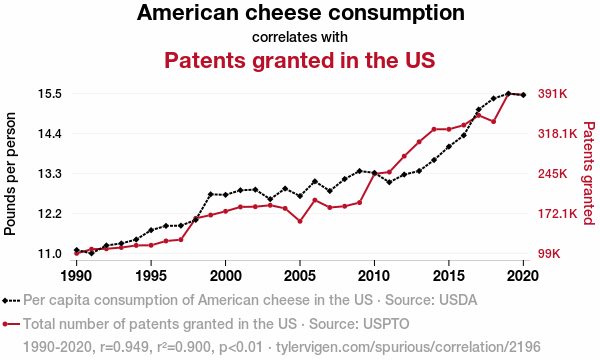
And yet, if presented without context, the graph alone can feel convincing.
Similarly, he found apparent correlation between the consumption of cheese and:
- The stock price of Google
- Google’s annual global revenue
- Amount of solar power generated in Haiti
- The stock price of Constellation Brands.
An a whole lot more – CLICK HERE to read the mind-boggling list!
Common Forms of False Cause
You’ll find this fallacy everywhere:
- Health Claims
“I took this supplement and got better—so it cured me.” - Business Decisions
“We redesigned the logo, and sales increased—so the logo caused the growth.” - Politics
“This law was passed, and the economy improved—so the law fixed the economy.” - Everyday Thinking
“I had a lucky charm, and things went well—so the charm works.”
In each case, other explanations are ignored:
- Coincidence
- External factors
- Underlying trends
Why It’s Dangerous
False cause reasoning can lead to bad decisions.
When we misidentify causes:
- We may repeat actions that don’t actually work
- We may ignore real factors that do matter
- We can be misled by confident but unsupported claims
In fields like medicine, economics, and public policy, this can have serious consequences.
How to Spot (and Challenge) It
When you hear a cause-and-effect claim, ask:
- Is there evidence beyond timing or correlation?
- Could something else explain the outcome?
- Has this relationship been tested or repeated?
A helpful rule:
If the connection seems surprising, it probably deserves more scrutiny.
The Bottom Line
The false cause fallacy turns coincidence into certainty.
It takes patterns that look meaningful and treats them as proof.
But real causation requires more than alignment—it requires explanation, evidence, and testing.
Because just because two things happen together…
doesn’t mean one made the other happen.
No Comments Yet