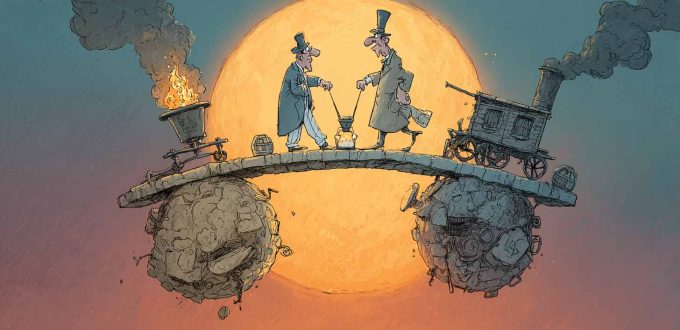
When You’re Given Only Two Choices (But There Are Many)
“You’re either with us or against us.”
It’s a powerful line. Simple. Clear. Memorable.
And often… completely misleading.
This is the false dilemma fallacy—also known as the false dichotomy. It happens when someone presents a situation as having only two options, when in reality, there are many more.
What Is a False Dilemma?
A false dilemma occurs when complex issues are reduced to an either/or choice, ignoring middle ground or alternative possibilities.
Instead of:
“There are several ways to approach this problem…”
You get:
“Either you support this plan, or you don’t care about the issue.”
It forces a decision—but on artificially limited terms.
Why It Works
False dilemmas are persuasive because they simplify reality.
Most real-world problems are messy, nuanced, and filled with trade-offs. But the human brain prefers clarity. Two options feel easier to process than five or ten.
So when someone frames an issue as a stark choice, it creates urgency and pressure:
- Pick a side
- Act now
- Don’t overthink
And in that rush, important alternatives disappear.
A Real-World Example (and Why It’s So Effective)
One of the most famous modern examples comes from political rhetoric following the September 11 attacks.
President George W. Bush stated:
“Either you are with us, or you are with the terrorists.”
It was a striking, emotionally charged statement—and incredibly effective in rallying support.
But logically, it presented a false dilemma.
In reality, there were many possible positions:
- Support the goal but question specific policies
- Advocate for different strategies
- Oppose certain actions while still condemning terrorism
None of those nuanced positions fit into the two choices presented.
Yet the framing made neutrality or criticism seem equivalent to siding with the enemy. It narrowed a complex global situation into a binary moral test.
That’s the power of a false dilemma: it doesn’t just simplify—it redefines disagreement as disloyalty.
Common Forms of False Dilemma
You’ll see this fallacy in many areas:
- Politics
“Either you support this bill, or you don’t care about public safety.” - Corporate Messaging
“Either we cut jobs, or the company fails.” - Advertising
“Use our product—or fall behind everyone else.” - Everyday Arguments
“If you don’t agree with me, you must be against me.”
Each example removes the middle ground where real solutions often live.
Why It’s Dangerous
False dilemmas don’t just oversimplify—they distort thinking.
When only two options are presented:
- Better alternatives may never be considered
- People feel pressured into choices they wouldn’t otherwise make
- Complex discussions collapse into polarized camps
Over time, this leads to more division and less problem-solving.
How to Spot (and Resist) It
The next time you hear an either/or argument, pause and ask:
- Are these really the only two options?
- What possibilities are being left out?
- Can both concerns be partially true?
Often, simply naming a third option breaks the illusion.
For example:
“Actually, there’s another approach we could consider…”
That one move can reopen the conversation.
The Bottom Line
False dilemmas are appealing because they make the world feel clear and decisive.
But clarity isn’t always truth.
Most important issues aren’t either/or—they’re both/and, neither/nor, or something in between.
And the moment you recognize that…
you’re no longer trapped by the choices someone else tried to give you.
No Comments Yet