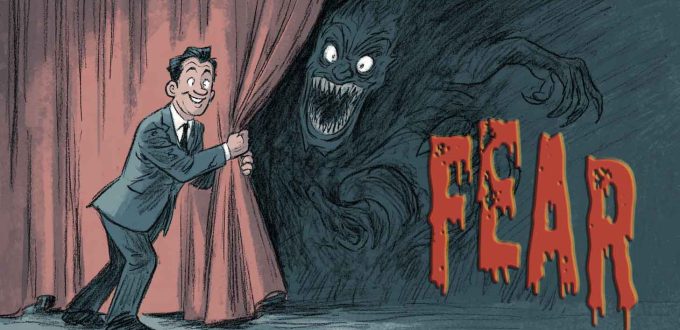
When Panic Replaces Proof
“Act now—or it could be too late.”
Few phrases are as powerful as a warning. Fear grabs attention, speeds up decisions, and makes risks feel immediate and personal. But when fear is used instead of evidence to persuade, it becomes a logical misstep known as the appeal to fear fallacy.
What Is an Appeal to Fear?
An appeal to fear occurs when someone tries to convince you by triggering anxiety or dread, rather than by presenting solid reasoning or data.
Instead of:
“Here’s evidence showing why this is a problem…”
You get:
“If you don’t do this, something terrible might happen.”
The conclusion may or may not be valid—but the argument relies on emotional pressure, not proof.
Why It Works
Fear is fast.
When we feel threatened, our brains shift into a rapid-response mode designed for survival. That’s useful in real danger—but in persuasion, it can short-circuit careful thinking.
Fear-based messages:
- Create urgency (“decide now”)
- Narrow attention (“focus on the threat”)
- Reduce skepticism (“better safe than sorry”)
In that state, we’re more likely to accept claims without fully evaluating them.
A Real-World Example (and Why It’s So Entertaining)
A memorable example comes from classic home security commercials.
Picture this: a quiet suburban house at night. Ominous music plays. A shadowy figure approaches a door. The narrator warns:
“This could be your home. Without protection, your family could be next.”
Cut to a reassuring scene of a brightly lit home with a security system installed.
The message is clear:
- Danger is lurking
- You are vulnerable
- The only way to stay safe is to buy this product
Now, home security can be a reasonable investment. But the ad’s argument doesn’t rely on statistics about break-in rates or comparisons between systems. Instead, it creates a vivid, emotionally charged scenario that makes the threat feel immediate and personal.
What makes it entertaining—once you notice it—is how quickly the story escalates. In a matter of seconds, you go from a quiet evening to imagining a break-in… all without any concrete evidence that this risk is likely or that this specific solution is the best one.
Examples Abound in Politics!
Common Forms of Appeal to Fear
You’ll see this fallacy in many contexts:
- Advertising
“Without this product, you’re at risk” - Politics
“If this policy passes, society will suffer” - Health Messaging
Emphasizing worst-case outcomes without context - Everyday Arguments
“If you don’t do this, something bad will happen”
Each one uses fear to push a conclusion.
When Fear Isn’t a Fallacy
Not all fear-based arguments are flawed.
If a warning is backed by clear evidence and realistic probability, it can be valid. For example, public health campaigns often highlight risks—but ideally, they also provide data and context.
The fallacy arises when:
Fear replaces evidence—not when it supports it.
Why It’s Dangerous
Appeals to fear can distort judgment.
When decisions are driven by anxiety:
- Risks may be exaggerated
- Alternatives may be ignored
- People may act impulsively
Over time, this can lead to poor decisions and unnecessary worry.
How to Spot (and Resist) It
When a message makes you feel afraid, pause and ask:
- What evidence supports this threat?
- How likely is this outcome, really?
- Are there other options being overlooked?
That moment of reflection can bring your reasoning back online.
The Bottom Line
Fear is a powerful motivator—but it’s not proof.
The appeal to fear fallacy works by making you feel something urgent, then attaching a conclusion to that feeling.
But good decisions require more than urgency—they require understanding.
Because the strongest arguments don’t just scare you…
they show you why you should act.