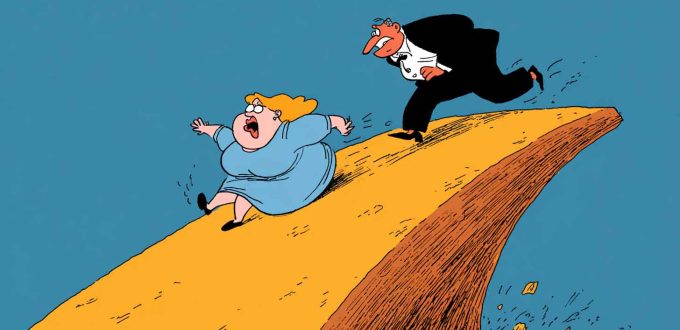
How Small Steps Get Turned into Big Fears
“If we allow this, what’s next?”
It’s a familiar line in debates, headlines, and everyday conversations. A small change is proposed—and suddenly, someone is predicting a cascade of disastrous consequences.
That’s the slippery slope fallacy: the idea that one action will inevitably trigger a chain reaction leading to extreme (and usually negative) outcomes—without sufficient evidence that such a chain will actually occur.
What Is the Slippery Slope Fallacy?
A slippery slope argument claims that taking one step will lead to a series of increasingly severe consequences, often ending in something absurd or catastrophic.
Instead of:
“This policy has potential risks we should evaluate…”
You get:
“If we allow this, it’s only a matter of time before everything falls apart.”
The key problem isn’t that consequences are impossible—it’s that they’re presented as inevitable without proof.
Why It Works
The slippery slope fallacy is powerful because it taps into fear of the unknown.
Humans are wired to anticipate danger. When someone paints a vivid picture of where something could lead, especially if it sounds alarming, we tend to take it seriously—even if the connection between steps is weak or speculative.
It also simplifies decision-making. Instead of evaluating a proposal on its own merits, the conversation jumps ahead to a hypothetical worst-case scenario.
A Real-World Example: Same-Sex Marriage Debates
In the years leading up to the 2015 Supreme Court decision in Obergefell v. Hodges, which legalized same-sex marriage in the United States, a common argument from some opponents followed a clear slippery slope pattern.
Public figures and commentators frequently claimed:
“If we allow same-sex marriage, what’s next? Polygamy? Marrying animals? The institution of marriage will completely collapse.”
This argument appeared in speeches, opinion pieces, and media commentary. It suggested that recognizing one specific type of marriage would inevitably lead to a cascade of increasingly extreme and unrelated outcomes.
Here’s one example that even uses the fallacy in the title:
Katherine Kersten: The perilous, slippery slope of gay marriage
Why This Is a Slippery Slope
At first glance, it sounds like a concern about consequences. But look more closely at the structure:
- Step 1: Legalize same-sex marriage
- Step 2: Expand to entirely different forms of relationships
- Step 3: Marriage loses all meaning
The problem is that no clear causal mechanism was demonstrated linking these steps. Legal frameworks for marriage are based on specific criteria (consent, adulthood, legal recognition), and changes to one aspect do not automatically trigger unrelated changes.
In fact, after the Obergefell v. Hodges decision, these predicted outcomes did not occur. The legal definition of marriage expanded—but it did not spiral into the extreme scenarios suggested.
Why It Was Persuasive
This argument worked because it:
- Framed the issue in terms of future risk rather than present policy
- Invoked fear of social instability
- Avoided debating the specific merits of same-sex marriage
Instead of asking, “Should same-sex couples be allowed to marry?” the conversation shifted to “What might happen if we start down this path?”
That shift is the hallmark of a slippery slope.
The Takeaway
This example shows how slippery slope arguments often:
- Jump from a specific policy change to broad societal collapse
- Skip over the need to prove each step
- Rely on fear rather than evidence
Recognizing this pattern helps you bring the discussion back to what actually matters:
Is the specific proposal reasonable and supported by evidence—on its own terms?
Converse Example: “Love Is Love” Framing
During public campaigns leading up to legalization in cases like Obergefell v. Hodges, many advocates used messaging such as:
“Love is love.”
“If two people love each other, they should be allowed to marry.”
Why This Can Be a Fallacy
These statements are powerful and persuasive, but logically they function as an appeal to emotion when used as the primary argument.
The reasoning structure becomes:
- Premise: Love is meaningful and valuable
- Emotional appeal: Denying love feels unfair or cruel
- Conclusion: Therefore, marriage rights should be granted
What’s missing (in a strict logical sense) is a fully developed argument addressing:
- Legal definitions of marriage
- Conflating various and conflicting definitions of “love” – e.g. the five loves in Greek or the four loves in Hebrew
- Constitutional principles (e.g., equal protection)
- Policy implications
Instead, the argument relies heavily on emotional resonance—fairness, empathy, and human connection—to persuade. This is an example of a well-intentioned but fallacious argument used to support a cause that could be properly supported other ways.
Important Clarification
This doesn’t mean the position itself is weak or incorrect.
In fact, many strong legal arguments in favor of same-sex marriage did not rely on emotional appeal, but on constitutional reasoning—particularly equal protection under the law, which ultimately formed the basis of the Court’s decision in Obergefell v. Hodges.
The fallacy arises only when:
Emotion replaces argument—not when it supports it.
A Solid Real-World Example: Net Neutrality Debate
During debates over net neutrality regulations—especially around the 2015 FCC Open Internet Order and its later repeal—some critics, including industry groups and commentators, made arguments that followed a classic slippery slope pattern.
A common claim was:
“If the government regulates internet service providers under net neutrality, it’s just the first step toward full government control of the internet.”
Some went further, suggesting it could lead to:
- Rate-setting across the entire industry
- Reduced innovation
- Eventual transformation of the internet into a heavily controlled public utility
Why This Is a Slippery Slope
The structure of the argument looks like this:
- Step 1: Implement net neutrality rules
- Step 2: Expand regulatory control
- Step 3: Government dominates or stifles the internet
The issue isn’t that regulation has no consequences—it’s that these arguments often presented a chain of escalating outcomes as inevitable, without demonstrating that each step would actually occur.
In reality, the 2015 rules were specific:
- They prohibited blocking, throttling, and paid prioritization
- They did not automatically impose broad pricing controls or total oversight
The argument also served to divert attention from the many harms that continued laissez-faire non-regulation promoted:
- Unfair promotion of lower-quality but higher-profit products
- Control of access to only sites that promote or profit the corporation
- Complete blocks on independent content
Whether one supports or opposes net neutrality, the claim that it would inevitably lead to sweeping government control relied on speculative progression rather than demonstrated causation.
Why It Was Persuasive
This argument gained traction because it:
- Framed the issue as a threat to freedom and innovation
- Shifted focus from specific rules to worst-case future scenarios
- Played on concerns about government overreach
Instead of debating the actual provisions of net neutrality, the conversation often moved to:
“What might this become?”
That’s the essence of the slippery slope—moving the debate away from the present and into a hypothetical future.
The Takeaway
This example shows how slippery slope arguments are often used in complex policy debates:
- A limited, specific proposal is reframed as the beginning of a sweeping transformation
- Intermediate steps are assumed rather than proven
- Fear of long-term consequences overshadows short-term analysis
Recognizing this pattern helps you slow the argument down and ask:
What evidence connects each step—and are those outcomes truly likely?
Common Forms of Slippery Slope
You’ll recognize this fallacy in many contexts:
- Politics
“If we pass this regulation, it will lead to total government control.” - Technology
“If we rely on automation, humans will lose all jobs.” - Workplace Decisions
“If we let one person work remotely, everyone will demand it and productivity will collapse.” - Parenting
“If I let them stay up late once, they’ll never follow a bedtime again.”
Each example assumes a chain reaction without demonstrating why each step must follow.
When It’s Not a Fallacy
It’s important to note: not all slippery slope arguments are wrong.
Sometimes actions really do lead to predictable consequences. The difference is evidence.
A valid argument shows:
- Clear causal links between steps
- Historical examples or data
- Reasonable probability—not just possibility
A fallacy skips those steps and jumps straight to the conclusion.
Why It’s Dangerous
Slippery slope thinking can block reasonable progress.
When worst-case scenarios dominate:
- Small, beneficial changes may be rejected
- Fear replaces analysis
- Conversations become exaggerated and polarized
It encourages people to argue against imagined futures instead of evaluating present realities.
How to Spot (and Challenge) It
When you hear a slippery slope argument, ask:
- What evidence connects each step?
- Are these outcomes likely—or just possible?
- Where could the chain realistically stop?
Often, simply questioning the inevitability breaks the illusion.
For example:
“Why would that necessarily happen?”
“What makes that outcome unavoidable?”
The Bottom Line
The slippery slope fallacy turns possibilities into certainties.
It takes a small step and stretches it into a dramatic narrative of decline.
But good reasoning doesn’t assume the worst—it examines the evidence.
Because not every path leads downhill…
and not every step sends you sliding out of control.